


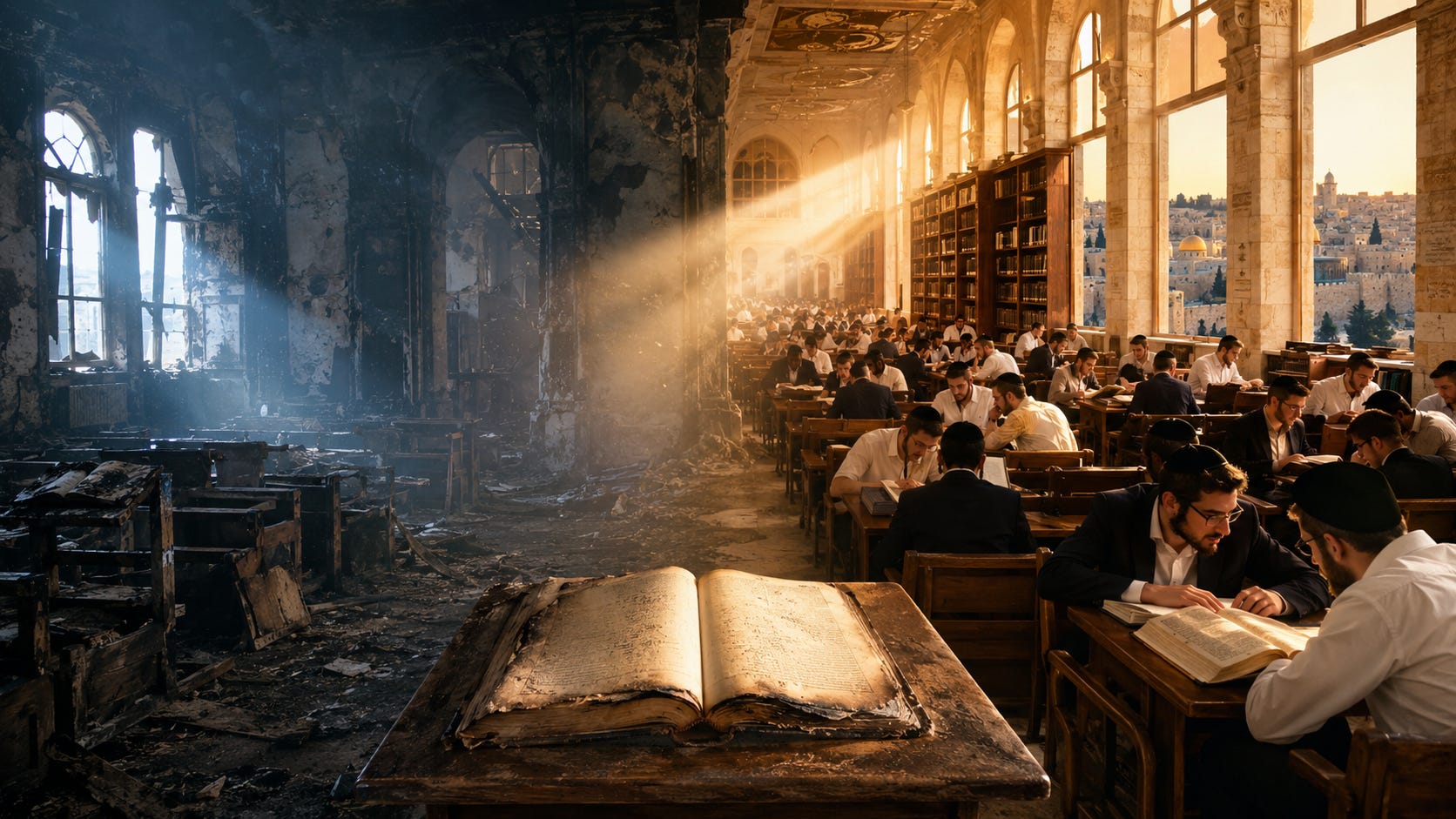
How a murdered Torah civilization rose again in Jerusalem, Bnei Brak, Brooklyn and Lakewood—and became larger than Europe had ever imagined
Walk past the Mir Yeshiva in Jerusalem late at night and listen.
The building is still alive. Thousands of voices rise and fall over pages of Gemara. Questions collide with answers. Fingers stab at Rashi. Someone insists that Rambam cannot possibly mean what his chavruta claims he means. Outside, buses grind through Jerusalem traffic. Inside, Babylonian arguments continue as if Hitler, Stalin, exile and history itself had failed to interrupt the conversation.
Drive into Bnei Brak and look up at Ponevezh glowing from its hill. Cross the Atlantic and enter the vast beit midrash of Lakewood. Visit a Bais Yaakov school in Jerusalem, a Hasidic court in Brooklyn, a hesder yeshiva in Gush Etzion or a Sephardi beit midrash where Rav Ovadia Yosef’s rulings are studied.
None of this was inevitable.
In 1945, much of it looked impossible.
There are historical facts so audacious that they sound like religious propaganda until you count the desks.
The Nazis and their accomplices murdered six million Jews. They did not merely kill individuals. They attempted to murder succession itself.
They killed the rabbis who carried traditions in their memories. They killed the children who were supposed to inherit those traditions. They emptied the yeshivot, burned the libraries, murdered the teachers, exterminated Hasidic courts and erased towns whose names had once meant something to every serious Jewish student.
Slabodka. Telz. Mir. Kletzk. Baranovich. Novardok. Lublin.
These were not quaint shtetls preserved under glass. They were living intellectual centers. Then they became killing fields, mass graves and names recited at memorials.
The miracle—yes, miracle is the correct word—is that they did not remain memorials.
They became blueprints.
Israel Was Not a Holocaust Consolation Prize
Let us dispose of one particularly lazy piece of historical nonsense before going any further.
Israel was not created because Europe felt guilty about the Holocaust.
Zionism was already transforming the Land of Israel decades before Auschwitz. Jews were building Hebrew cities, draining swamps, planting vineyards, establishing universities, forming defense organizations and reviving an ancient language while Europe was still deciding which antisemitic conspiracy theory it preferred.
Baron Edmond de Rothschild was financing Rishon LeZion, Zikhron Ya’akov, Rosh Pinna and Ekron in the nineteenth century. Tel Aviv was founded in 1909. The Hebrew University opened in 1925. Jewish statehood was not a pity voucher handed to refugees by embarrassed Europeans.
The Holocaust did not create the Jewish people’s right to sovereignty. It demonstrated, in six million graves, the price of being denied it.
Before Israel, a Jew fleeing murder had to beg an imperial clerk for permission to live.
After Israel, that Jew became an oleh.
That difference is Zionism.
At its peak in 1947, Europe’s Jewish displaced-persons population numbered approximately 250,000. They had survived ghettos, camps, forests, forced labor and death marches, only to find themselves behind barbed wire again, waiting for countries to decide whether Jews were convenient enough to admit.
Then, in May 1948, the gates opened.
Not because Britain had suddenly discovered its conscience. Not because the United Nations had become emotionally attached to Jewish survival. The gates opened because the Jews had a state, an army, a flag, ships and the power to say the two most important words in postwar Jewish history:
Come home.
The Survivors Carried More Than Suitcases
The survivors who arrived in Israel and America did not bring much property. Many possessed a few clothes, scraps of paper and photographs of people who no longer existed.
But certain survivors carried entire civilizations inside their heads.
They remembered how their rabbis had learned a passage of Talmud. They remembered the melodies of courts that had been annihilated. They remembered customs no surviving book had adequately recorded. They remembered which question Rav Chaim Brisker had asked, how the Alter of Slabodka had developed a student and how a particular rebbe had conducted a tisch in a town whose Jewish population was now ash.
The first reconstruction project was therefore not architectural. It was human.
Save the teachers.
Find the students.
Print the books.
Feed whoever remains.
The Mir Yeshiva became the most extraordinary example. It was the only major Eastern European yeshiva to survive the Holocaust substantially intact. Hundreds of its students escaped Lithuania, crossed the Soviet Union and reached Japan and Shanghai using transit documents connected to the Dutch consul Jan Zwartendijk and the Japanese diplomat Chiune Sugihara.
While millions of Jews were being murdered, the Mir students continued learning in Shanghai.
Think about the sheer defiance of that sentence.
Hitler controlled much of Europe. German armies were advancing across continents. Jewish civilization was being fed into crematoria. And in a sweltering building in Japanese-occupied Shanghai, displaced young Jews were arguing over the Talmud.
The Nazis commanded an empire.
The boys had Gemaras.
The empire is gone.
The Gemaras are still open.
After the war, the Mir tradition was reestablished in Jerusalem and Brooklyn. Rav Eliezer Yehuda Finkel rebuilt in Jerusalem. Rav Avraham Kalmanowitz helped preserve and rebuild the American branch. A European institution that once numbered roughly 500 students became the ancestor of vast centers educating thousands.
That was not restoration.
That was resurrection with an expansion plan.
Rav Kahaneman Refused to Build a Tombstone
Rav Yosef Shlomo Kahaneman, the Ponevezher Rav, lost his community and much of his family. He could have responded by constructing a dignified memorial to the murdered Ponevezh Yeshiva.
Instead, he built another Ponevezh Yeshiva.
He arrived in Eretz Yisrael in 1940 and began again in Bnei Brak with a handful of students. He raised money relentlessly. He dreamed on a scale that must have appeared slightly unhinged to anyone looking at the ruins of European Jewry.
Good.
Normal expectations were not going to rebuild anything.
Ponevezh rose on its hill not as a replica of Lithuania but as what Rav Kahaneman called a living memorial. Its classrooms would not contain exhibitions about dead students. They would contain living students producing more students.
A plaque remembers a person.
A yeshiva creates grandchildren.
That distinction explains much of what followed.
The Mir, Ponevezh, Chevron, Brisk and Kamenitz were rebuilt or enlarged in Jerusalem and Bnei Brak. Rav Kahaneman, Rav Eliezer Yehuda Finkel, the Chazon Ish, the Brisker Rav, Rav Isser Zalman Meltzer, Rav Yechezkel Sarna, Rav Shmuel Rozovsky and Rav Elazar Menachem Shach did not all possess identical philosophies. But collectively, they relocated the center of Lithuanian Torah learning from a murdered Europe to the Land of Israel.
They planted it in Jewish soil.
And it grew wildly.
The Two Moshes
Perhaps no story captures this reconstruction more beautifully than the story of two young men in Rav Moshe Schneider’s wartime Toras Emes Yeshiva in London.
Both were named Moshe.
The yeshiva was desperately poor. A bakery reportedly agreed to provide leftover bread if someone collected it. One of the boys faithfully walked to fetch the bread for the other students.
The second boy accepted another unpopular responsibility: waking everyone for davening and learning.
According to the account preserved among Rav Schneider’s students, he blessed the bread collector that the world would one day know of his wealth. He blessed the boy who awakened the students that the world would one day know of his Torah.
The bread collector was Moshe Yosef Reichmann—known to the business world as Paul Reichmann.
The boy who woke the students was Rav Moshe Shternbuch.
One became one of the most formidable property developers of the twentieth century. Reichmann’s Olympia & York constructed New York’s World Financial Center and London’s Canary Wharf. At its peak, the family fortune reached into the billions.
The other became one of the most significant Haredi halachic authorities of his generation in Jerusalem.
One carried the Torah.
The other paid for the bread.
That formulation is not meant to diminish Reichmann. Quite the opposite. He understood that wealth was not the conclusion of his story. It was an instrument.
The Reichmann family reportedly donated as much as $50 million annually to yeshivot, synagogues, schools, hospitals and struggling families. They established mechanisms in Jerusalem and Bnei Brak to relieve yeshivot of crushing debts. They supported institutions across Israel, Canada, America, France and Morocco. Much of the giving was anonymous.
Even Olympia & York’s enormous construction sites closed for Shabbat and Jewish holidays. Imagine the audacity: cranes resting above some of the world’s most expensive real estate because a Jewish boy who once collected yesterday’s bread had not forgotten who he was.
Paul Reichmann later reportedly said that he wished he had been the boy who received the blessing for Torah greatness.
That may be the most revealing detail of all.
The billionaire envied the scholar.
Yet the scholar’s world could not have survived without the billionaire.
That is Jewish reconstruction in one story: the word and the bread, the teacher and the donor, the Gemara and the payroll.
America Was Not a Torah Desert
The popular version of this history sometimes suggests that observant refugees arrived in a completely barren America and invented Orthodoxy from scratch.
That is not true.
RIETS and Yeshiva University had roots stretching back to 1886. Torah Vodaath was founded in 1918. Chaim Berlin, Ner Israel and other institutions existed before the war. American Orthodox Jews had already built synagogues, schools, kashrut organizations and communal networks.
But the refugees changed the ambition, intensity and authority of American Orthodoxy.
Rav Aharon Kotler founded Beth Medrash Govoha in Lakewood in 1943 with approximately fourteen students. He insisted that advanced Torah study could exist in America not as a hobby performed after work, but as a consuming intellectual vocation.
By Rav Kotler’s death in 1962, Lakewood had approximately 200 students.
Today, it has more than 9,000.
Fourteen to more than 9,000.
That is not nostalgia. That is a demographic detonation.
Rav Kalmanowitz rebuilt the Mir in Brooklyn. Rav Eliyahu Meir Bloch and Rav Chaim Mordechai Katz reestablished Telshe in Cleveland. Rav Yitzchok Hutner shaped Chaim Berlin. Rav Yaakov Kamenetsky led Torah Vodaath. Rav Yaakov Yitzchok Ruderman built Ner Israel. Rav Moshe Feinstein became the address to which American Jews sent their most difficult halachic questions.
At Yeshiva University, Rav Joseph B. Soloveitchik and Samuel Belkin developed another postwar model: rigorous Torah scholarship living in conversation with universities, professions and modern American life.
These approaches disagreed—sometimes loudly. That too was evidence of success. Dead civilizations do not argue about educational philosophy.
Living Jews do.
The Women Who Made the “Society of Learners” Possible
Any history that discusses only roshei yeshiva is not merely incomplete. It cannot explain the bank account.
The Torah world was also rebuilt by women.
Bais Yaakov schools operated even in displaced-persons camps, where traumatized teachers attempted to educate traumatized girls using almost no supplies. Vichna Kaplan opened America’s first Bais Yaakov high school in Williamsburg in 1938. After the war, Bais Yaakov schools and seminaries spread across Israel and the United States.
They trained teachers. They educated mothers. They created administrators. They gave Orthodox women access to serious textual education. They also prepared women to enter the workforce.
That last point is not a footnote.
The postwar kollel system depended heavily on women who earned salaries while their husbands studied. They taught classes, raised children, managed households, stretched budgets and built the domestic structure beneath the beit midrash.
The “society of learners” rested on a society of women working incredibly hard.
Torah Umesorah, founded under the leadership of Rav Shraga Feivel Mendlowitz and developed nationally by Dr. Joseph Kaminetsky, helped transform Jewish day-school education in America. Chinuch Atzmai, established in Israel in 1953 with leaders including Rav Zalman Sorotzkin and support from Rav Aharon Kotler, created an independent Haredi school network.
By 2013–14, approximately 255,000 pupils attended 861 Jewish day schools in the United States. The fastest expansion was concentrated in Hasidic and yeshiva-world schools.
This is how a civilization survives.
Not through an annual commemorative dinner.
Through first grade.
The Hasidic Courts Became Cities
Hasidic reconstruction required more than locating surviving rebbes.
A rebbe without a community is a voice without an echo.
Ger, Belz, Vizhnitz, Satmar, Klausenburg, Bobov, Skver and Chabad rebuilt in Israel and North America. But the postwar courts often became more organizationally extensive than their European predecessors.
They created schools, housing projects, charities, businesses, matchmaking networks, welfare systems and medical institutions. They functioned as spiritual communities, social-service organizations and, at times, miniature municipalities.
The Vizhnitzer Rebbe, Rav Chaim Meir Hager, developed Kiryat Vizhnitz in Bnei Brak. Rav Yoel Teitelbaum built Satmar into an enormous transatlantic community centered in Williamsburg. Rav Shlomo Halberstam rebuilt Bobov in America. Rav Yaakov Yosef Twersky created New Square.
The Klausenburger Rebbe, Rav Yekusiel Yehuda Halberstam, survived the camps after losing his wife and eleven children. He came to Israel and built Kiryat Sanz and Laniado Hospital.
Read that again.
A man whose wife and eleven children were murdered built a hospital devoted to saving lives.
That is not merely survival.
That is a theological counterattack.
Chabad followed yet another path. Rav Yosef Yitzchak Schneersohn reached America in 1940. Under the leadership of the Lubavitcher Rebbe, Rav Menachem Mendel Schneerson, Chabad eventually sent emissaries throughout the world.
Hitler attempted to make the Jew homeless everywhere.
Chabad responded by opening a Jewish home almost everywhere.
The Torah Renaissance Was Not Only Haredi
The postwar rebuilding cannot be reduced to the Lithuanian yeshiva world or Hasidic courts.
Religious Zionists built a different Torah society—one that rejected the idea that a Jew must choose between a page of Gemara and responsibility for the Jewish state.
Rav Moshe-Zvi Neria opened the first Bnei Akiva yeshiva at Kfar Haroeh in 1940 with thirteen students. Rav Chaim Yaakov Goldvicht developed Kerem B’Yavneh, which became the prototype for hesder: serious Torah study combined with military service.
Rav Tzvi Yehuda Kook transformed Mercaz HaRav into the intellectual engine of a generation. Holocaust survivor Rav Yehuda Amital helped formulate hesder and later founded Yeshivat Har Etzion. Rav Aharon Lichtenstein joined him, creating a beit midrash that combined intellectual rigor, moral seriousness and commitment to the State of Israel.
These institutions produced rabbis, soldiers, educators, officers, judges, scientists and public servants. Their students carried Gemaras into military bases and military responsibility back into the beit midrash.
This was also Torah reconstruction.
So was the Sephardi renaissance.
Jews arriving from Iraq, Morocco, Yemen, Syria, Egypt and across North Africa were not remnants of the destroyed European yeshiva world. They carried their own ancient traditions into Israel.
Porat Yosef, established in Jerusalem in 1923, became the central academy of modern Sephardi Torah scholarship. After its Old City home was destroyed in 1948, it was rebuilt. Rav Ezra Attiya trained a generation that included Rav Ovadia Yosef, Rav Ben-Zion Abba Shaul and Rav Yehuda Tzadka.
Rav Ovadia’s mission to “restore the crown to its former glory” was not a decorative slogan. It was an attempt to rescue Sephardi halachic authority from marginalization and make it national again.
Israel did not produce one Torah world.
It produced several—and gave them enough freedom to disagree ferociously.
The State Some Opposed Helped Them Flourish
Here comes the historical paradox that polite accounts often tiptoe around.
Many Haredi leaders did not accept Zionist theology. Rav Moshe Shternbuch himself has been a forceful opponent of Zionism. Satmar rejected the state ideologically. Other Haredi leaders treated Israel as a practical reality rather than the beginning of redemption.
Fine.
History does not require ideological tidiness.
But geography has receipts.
The largest Torah renaissance in Jewish history developed within the State of Israel.
The state opened the gates. It absorbed survivors. It provided roads, electricity, water, hospitals, security and municipal infrastructure. It recognized independent religious school systems. It funded schools, yeshivot and kollelim. It permitted religious political parties to negotiate for their communities.
And Jewish soldiers—religious and secular—defended the country in which every Jew retained the freedom to argue over whether the state was religiously significant.
People may debate theology.
They cannot debate plumbing.
In 1948, David Ben-Gurion approved military deferments for approximately 400 yeshiva students. The measure was partly intended to preserve the remnants of a Torah world that had just been slaughtered.
By 2023, Israel counted approximately 169,000 students in postsecondary yeshivot and kollelim. In 2023–24, roughly 401,000 children attended Haredi schools—about one-fifth of all Israeli pupils.
The categories are not identical. The original 400 counted deferments, while the modern figure counts broader enrollment. But no statistical footnote can conceal the direction of history.
Four hundred endangered students became a society of learners.
That achievement deserves respect.
It also raises a legitimate contemporary question. An emergency rescue arrangement cannot automatically settle every debate about military service, public funding or shared citizenship eight decades later. A mature forest cannot permanently demand to be treated as twelve endangered saplings.
One can honor the rescue of the Torah world and still insist that every part of Israeli society participate seriously in protecting the Jewish future.
Gratitude is not a veto on responsibility.
The Checkbook Was Part of the Miracle
There is no honest ranking of “the greatest philanthropists to Israel” because philanthropy cannot be measured only by the size of a check.
Moses Montefiore supported Jerusalem’s early neighborhoods, public health and economic development. Baron Edmond de Rothschild kept early agricultural settlements alive and helped establish the economic foundations of the Yishuv. Nathan Straus financed health and welfare projects. Henrietta Szold and Hadassah built medical and educational institutions and helped rescue children through Youth Aliyah.
The Rothschild family’s Yad Hanadiv later financed buildings that physically express Israeli sovereignty and civilization: the Knesset, the Supreme Court and the new National Library of Israel.
The Azrieli family invested in education, medicine, research and Israeli social resilience. Charles Bronfman and Michael Steinhardt helped create Birthright Israel. The Schusterman family invested in Israel, Jewish education and young leadership. Bernie and Billi Marcus supported Israeli medicine, emergency services and aliyah. Sheldon and Miriam Adelson poured historic sums into Birthright, Yad Vashem, medical research, Jewish education and unapologetic defense of Israel.
The Reichmanns financed yeshivot, kollelim, schools, hospitals and families. Other families—the Wolfsons, the Grusses and many more—quietly carried institutions through years when tuition and government support could not cover expenses.
Then there were the millions of ordinary Jews who gave through the United Jewish Appeal, Jewish Federations, Keren Hayesod and the Jewish National Fund.
No billionaire built Israel alone.
The collective effect of ordinary Jews writing modest checks year after year may exceed that of any individual donor. A grandmother in Johannesburg, a shopkeeper in Brooklyn, a dentist in Toronto and a family in Phoenix may never have seen their names carved into Jerusalem stone.
Their money is nevertheless inside the stone.
The great philanthropists funded different visions of Jewish life. Some supported universities. Others built hospitals. Others purchased ambulances, planted forests, brought immigrants home or kept yeshivot solvent.
They did not necessarily share religious beliefs or political positions. They might not have survived ten minutes at the same dinner table.
But nation-building does not require everyone to agree.
It requires enough people to build.
What Was Rebuilt Was Not the Same
The postwar Torah world described itself as a continuation of Europe. That was true—but only partly.
It was also something new.
Historian Haym Soloveitchik famously described a transition from a mimetic religious culture, absorbed naturally through family and community, to a more text-centered Orthodoxy governed by schools, books and formal rabbinic authority.
In Europe, much of Jewish practice had been learned by watching parents, neighbors and local rabbis. But what happens when the parents are dead, the neighbors have vanished and the town is a cemetery?
The book must perform the work once done by the street.
The yeshiva must replace the community.
The rav must answer questions once resolved through inherited custom.
Postwar Orthodoxy therefore became more institutional, more centralized, more textually self-conscious and, in certain areas, more stringent. Hasidic courts became larger organizations. Rabbinic authority crossed national borders. Girls’ education became systematic. Full-time study for married men expanded from a comparatively limited elite practice into the central ideal of an entire Haredi society.
This was not Europe reconstructed brick for brick.
It was Europe remembered, distilled and redesigned for Jerusalem, Bnei Brak, Brooklyn and Lakewood.
The people who claimed to be preserving tradition were also among the most audacious social innovators in modern Jewish history.
Why Has This Story Been Neglected?
This reconstruction is under-studied relative to its enormous importance.
Holocaust history often ends at liberation, the displaced-persons camps or immigration.
Israeli history usually proceeds through Ben-Gurion, the War of Independence, mass aliyah, the kibbutzim, the IDF, the Six-Day War and the political battles of the state.
American Jewish history prefers Ellis Island, suburbanization, universities, civil rights and liberal religious movements.
The yeshiva world falls between the filing cabinets.
Secular historians sometimes treated Haredim as a fossilized remnant—people standing still while modern history happened around them. Internal Haredi histories often went in the opposite direction, producing inspirational biographies rich in saintly personalities and miraculous episodes but thin on budgets, institutional politics, women’s labor, government negotiations and organizational innovation.
One side saw backwardness.
The other saw only greatness.
Neither fully explained how the electricity bill was paid.
The archives are also difficult. Records were destroyed. Others remain in private yeshiva, dynasty and family collections. Sources are scattered across Yiddish letters, rabbinic correspondence, fundraising ledgers, oral histories, newspapers and recordings that major libraries ignored for decades.
The story is also ideologically inconvenient.
It reveals that anti-Zionist communities flourished under Jewish sovereignty.
It reveals that people defending tradition introduced radical innovations.
It reveals that the ideal of male full-time study depended heavily on female education and employment.
It reveals that American liberty, supposedly the great solvent of religious identity, allowed disciplined Orthodox enclaves to grow.
And it reveals that the State of Israel was not merely a political refuge. It became the physical platform for the greatest concentration of Torah study in history.
Scholars including Menachem Friedman, Haym Soloveitchik, Michal Shaul, Benjamin Brown, Kimmy Caplan, Yoel Finkelman and Marcin Keren-Kratz have begun filling this enormous gap. Michal Shaul’s work is especially important: she estimates that Haredi survivors may have constituted only 6–10% of Israel’s surviving remnant, yet they played a disproportionate role in rebuilding yeshivot, Bais Yaakov schools, Hasidic courts and the social ideal of sustained Torah study.
The field is growing.
It is about time.
Against All Odds
This is not a story about one religious faction defeating another.
It is the story of a people rebuilding every part of a civilization.
Zionists built sovereignty.
Soldiers defended it.
Farmers cultivated its soil.
Doctors built its hospitals.
Engineers built its roads.
Hebrew educators rebuilt its language.
Sephardi sages restored traditions carried from Baghdad, Aleppo, Fez and Sana’a.
Hasidic rebbes rebuilt communities from broken families.
Roshei yeshiva rebuilt academies from murdered student bodies.
Women built schools, homes and livelihoods.
Philanthropists converted private success into public continuity.
And survivors who had every reason to surrender to grief instead married, had children and began again.
That may be the greatest act of defiance of all.
“Against all odds” is not sentimental language. The odds were measurable.
Six million murdered.
Thousands of communities erased.
A quarter-million displaced Jews waiting behind fences.
Five hundred students in the prewar Mir.
Fourteen in early Lakewood.
Approximately 400 Israeli yeshiva deferments in 1948.
Then came Mir and Ponevezh, Lakewood and Telshe, Bais Yaakov and Torah Umesorah, Chinuch Atzmai and Porat Yosef, Mercaz HaRav and Har Etzion, Kiryat Sanz and Kiryat Vizhnitz.
Then came thousands of schools, hundreds of thousands of students and millions of Jewish children who would know Torah not as the relic of a murdered civilization, but as the living language of their homes.
The murderers wanted the Jew reduced to an exhibition in somebody else’s museum.
Instead, the Jew returned to Jerusalem.
He opened a school.
He built a hospital.
He argued with his government.
He paid taxes, complained about tuition, missed the bus, served in the army, protested the army, raised money and stayed awake far too late debating a line of Gemara written fifteen centuries earlier.
In other words, he became alive.
They burned the books.
We built libraries.
They emptied the towns.
We built cities.
They tried to make the Jew a memory.
The Jew returned home—and opened the Gemara.
Uplifting story . But now, that the world of Torah has been rebuilt in the State of Israel, it is a time to return Ben Gurion's deferments favor and start to serve the country like everybody else .
Bravo 🙌 What a fantastic achievement for the Jewish people❣️🙌 So inspiring and lovely❣️I stand with Israel and all her people worldwide ❣️🙏🇮🇱🇮🇱🇮🇱💯