

Sacred Lambs

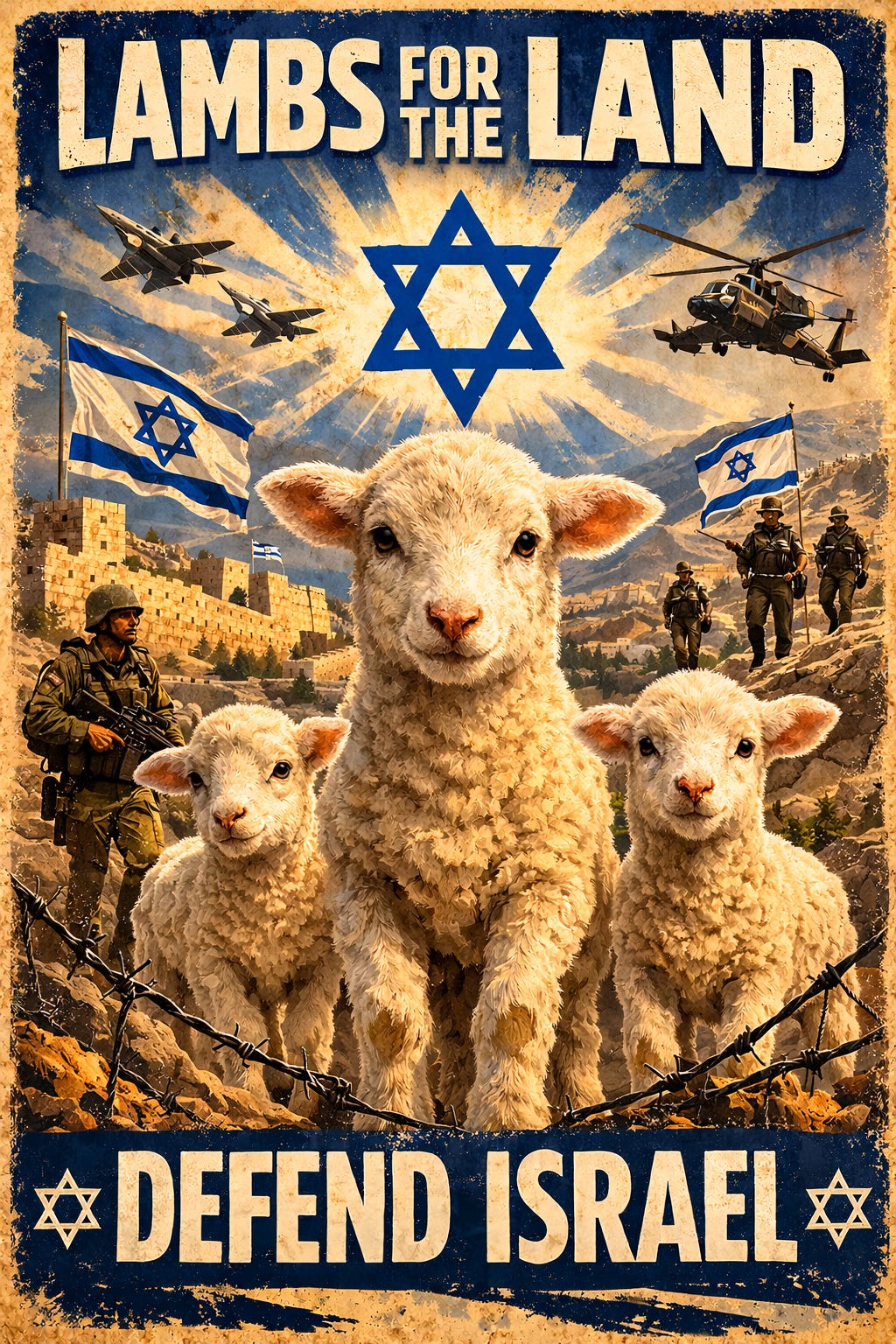
There is a reason the story of a lamb sits at the very center of Jewish history.
Not power. Not kings. Not armies.
A lamb.
In the Torah, on the night the Jewish people became a nation, every family was told to take a lamb, hold it close, and then sacrifice it. They placed its blood on their doorposts as a sign. It was not ritual for the sake of ritual. It was a line drawn in history.
It said: we are no longer hiding. We are no longer living quietly under someone else’s rule. We are stepping into who we are.
The lamb became the symbol of that moment. Innocence, yes. But also courage. Because it takes courage to act when everything in you wants to stay safe.
Jewish tradition didn’t leave this idea behind in ancient times. The Talmud explains something most people don’t expect. The offering of a lamb was never about feeding God or pleasing Him. It was about transformation.
It was a way of saying: something in me needs to grow. Something in me needs to be lifted higher.
The Midrash goes even deeper. It asks why the Jewish people are compared to a lamb. Not a lion, not something strong and dominant.
Because a lamb survives not through power, but through endurance. Through faith. Through a refusal to disappear, even when surrounded by wolves.
That is the Jewish story.
And that story is tied, inseparably, to one place: the Land of Israel.
Not just as a piece of land, but as the place where values become real. Where responsibility, community, and faith are not ideas but daily life. Where giving, building, and sustaining are part of something much bigger than any one person.
That’s where Tzedakah comes in.
It doesn’t mean charity.
It means responsibility.
It means recognizing that if you have the ability to help sustain life, to build something meaningful, to strengthen a people and a land, then standing on the sidelines isn’t neutral. It’s a choice.
Moses Maimonides taught that the highest form of giving is not about generosity. It’s about dignity. About helping something stand, grow, and continue.
And that is exactly what “Lambs for the Land” is.
This is not a metaphor. It is real life. Real animals. Real land. Real people working, building, sustaining something that connects directly back to the earliest roots of the Jewish story.
It is taking the symbol of the lamb, the same one that marked the birth of a nation, and bringing it back into the land where that nation still fights, still builds, still refuses to disappear.
Abraham Isaac Kook wrote that rebuilding the land of Israel is not just physical work, it is spiritual. Every act of building, planting, sustaining life in that land carries meaning far beyond what the eye can see.
So this is not just a project.
It is continuity.
It is identity made tangible.
It is a way for someone, anywhere in the world, Jewish or not, to take part in something ancient, real, and alive.
And here is the part where I stop explaining and start asking.
If this moved you, even a little, don’t reduce it to a nice thought and move on with your day. That’s what people do when they want to feel something without being changed by it.
Consider supporting Lambs for the Land.
Not out of obligation.
Not out of pressure.
But because something in you recognizes that this matters.
Because you understand that history is not just something we read about. It is something we either carry forward, or quietly let fade.
And to those of you who have already supported this, who have already stepped in and said “I want to be part of this,” understand what you’ve done.
You chose to stand with life.
You chose to stand with a people and a land that have endured more than most can even comprehend.
You chose action over indifference.
That is not small.
That is exactly how history continues.
Lambs for the Land is a project of Unity Warriors, a registered U.S. 501(c)(3) nonprofit organization. All donations are fully tax-deductible under U.S. law.
I love your therapy farm and already have adopted two lambs, but I look forward to adopting a whole herd before I leave this earth!
Speaking of lambs.
The wool industry has cratered in the past 40 years. I believe it had to do first with crappy cheap acrylic yarns and then with cheap Peruvian wool imports, but all over the UK and Scandinavia, they have pretty much stopped using their sheep for wool and only use them for meat because shearing them doesn't pay. That means if you actually want a warm sweater, you have to buy the wool from one of the few remaining producers and make your own, and that wool is not cheap because it's hard to find. I learned to knit in 1980 because I couldn't buy a warm sweater and needed one. I was living in New England where it gets really cold, and I've made almost all my sweaters since.
This winter I made Aliyah to Haifa, where they have green winters; it generally doesn't get much colder than the 50s, but it's colder in the apartment than it is outside. I hadn't brought my warm sweaters and I needed them. In Israel, where it's supposed to be hot, I have frozen my butt off all winter. The clothing stores don't sell sweaters made of wool, just that cheap synthetic crap that doesn't keep you warm. The yarn stores don't sell wool, just cotton and more of that cheap synthetic crap.
I am writing because if you're raising lambs, there is a market opportunity staring you in the face. Shear the wool. You don't even need to spin it into yarn, you could sell the raw stuff, which they call "roving."
You could say, well what about New Zealand merino wool? I would say that stuff is good against the skin, it's hypo-allergenic, but it's not very warm.
Micro-producers tend to sell online to an international market, e.g., via Etsy. It's a possible revenue source.