

Stolen Soul!
Tzfat Tried to Break My Knees. Then Shabbat Stole My Soul.

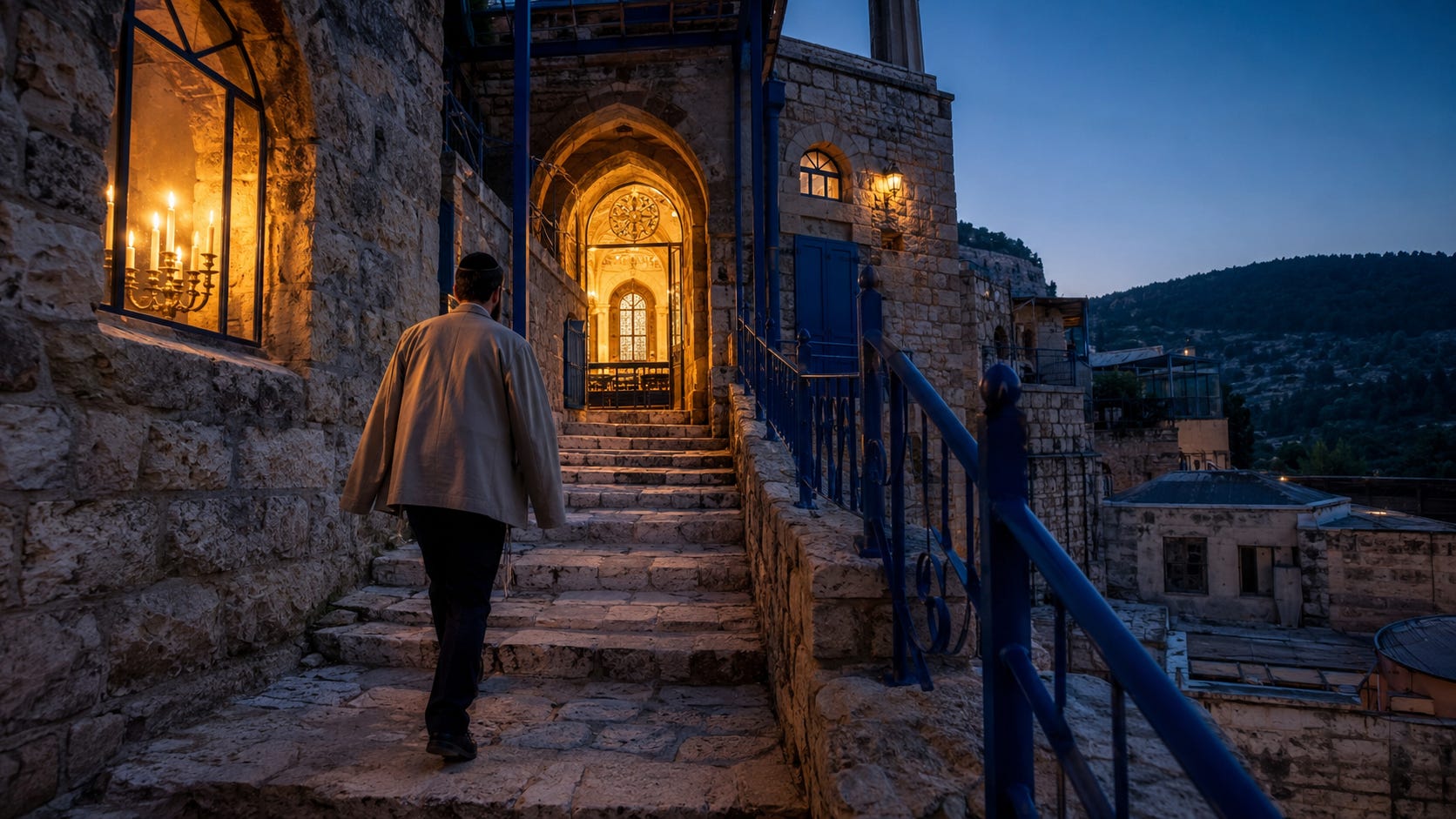
By Friday afternoon, Tzfat had attempted to murder my knees, confuse my GPS, and force me into a deeply personal relationship with gravity.
Every street is either a staircase, the beginning of a staircase, or a staircase pretending to be a road. Google Maps tells you to turn right. There is no right. There is a blue door, three cats and a wall built when the Ottoman Empire still had a functioning complaints department.
The entire city is so vertically unequal that Amnesty International may soon issue a report. Ireland will recognize the lower alley as an oppressed state. The United Nations will condemn the upper city for disproportionate elevation.
This is Tzfat.
High in the Upper Galilee, wrapped in cool mountain air and Jewish history, Tzfat does not gently introduce itself. It grabs you by the ankles and drags you uphill through five centuries of mysticism.
White stone. Blue railings. Arched passageways. Ancient synagogues wedged into alleys barely wide enough for one rabbi and half an argument. Through gaps between rooftops, the green mountains roll toward Meron.
Then Friday begins its usual Israeli military operation: acquire challah, finish cooking, find the missing shoe, shower the children, iron a shirt and discover that candle-lighting is somehow seven minutes earlier than every person in the house believed.
In Tzfat, the entire operation happens uphill.
Yet as sunset approaches, the city changes.
Shops close. Cars vanish. Aluminum trays disappear through doorways. Men in white shirts hurry toward shul. Women light candles behind old windows. The frantic machinery of Friday suddenly shuts down, and the mountain exhales.
Tzfat becomes quiet.
Not dead quiet. Living quiet.
You can hear footsteps on stone. A chair moving across a floor. A child calling from an upstairs window. The first notes of prayer slipping out of a synagogue.
Then comes Lecha Dodi.
This is its hometown.
Rabbi Shlomo Alkabetz composed the hymn here during Tzfat’s extraordinary sixteenth-century golden age. The mystics would go out toward the fields at sunset to greet Shabbat as a queen and bride. That practice became Kabbalat Shabbat, carried from these Galilean hills into Jewish communities across the planet.
Every Friday night, Jews in Morocco, Poland, Yemen, Baghdad, Johannesburg, Scottsdale and Efrat sing words born in Tzfat.
Think about that. A mountain town with no airport, no seaport and no marketing department created one of the most universal moments in Jewish life.
TikTok influencers beg for twelve seconds of attention. Tzfat released Lecha Dodi nearly five hundred years ago, and it still trends every Friday night.
Standing in shul, hearing those words rise against the stone walls, I understood that this was not merely another melody before Maariv. This was the home-field anthem.
Nobody asked us to visualize abundance. Nobody distributed healing crystals. Nobody charged $1,800 for a “transformative sound journey” followed by organic cucumber water.
We sang.
That was enough.
Tzfat became a Jewish intellectual powerhouse after the expulsion from Spain in 1492 sent Jewish refugees across the Ottoman world. Scholars, merchants, rabbis and mystics arrived carrying Torah, commercial experience and memories of homes stolen from them.
They built again.
The city developed a thriving textile industry, but its most valuable exports were ideas.
Rabbi Yosef Karo lived and taught here. His Shulchan Aruch became the foundation of practical Jewish law, guiding Jewish life from the kitchen to the synagogue.
Rabbi Moshe Cordovero organized generations of Kabbalistic thought into a coherent system.
Then Rabbi Yitzchak Luria—the Ari—arrived in Tzfat around 1570. He taught here for roughly two years before dying at only thirty-eight, yet those two years transformed Jewish mysticism.
Two years.
I have kept bottles of salad dressing longer than the Ari taught in Tzfat, and the salad dressing has influenced absolutely nobody.
The Ari’s teachings about creation, concealment, shattered vessels and spiritual repair reshaped the Jewish understanding of human responsibility. A mitzvah was never merely a private religious act. Prayer was not empty recitation. Every Jewish action carried weight far beyond the visible world.
Empires could exile a Jew, tax him, humiliate him and steal his house. They could not make him irrelevant.
That idea is pure Jewish defiance.
Tzfat placed Jewish law and Jewish mysticism in neighboring alleys. Rabbi Yosef Karo taught Jews how to live. The Ari explained why the universe trembles when they do.
The modern wellness industry now sells “intentional living” in beige packaging. Tzfat did it with Torah, mitzvot, a minyan and no promotional code.
Then came the Shabbat meal.
Wine. Challah. Hot food. Torah. Singing. Actual human conversation without a glowing rectangle interrupting every eleven seconds to announce that a celebrity has changed shampoo brands.
A Shabbat table in Tzfat obeys its own laws of physics. An extra chair appears. A visitor discovers that the host knows his cousin. One niggun lasts fourteen minutes. By dessert, everyone has shared a Torah insight, a family history and a medical opinion despite nobody present having attended medical school.
This is Israel. We contain multitudes, and all of them recommend magnesium.
Outside, songs drift through open windows. One melody ends and another begins farther down the alley. The city becomes a scattered choir.
Western retreats charge thousands for a “digital detox.” Shabbat provides the original package every week: wine, bread, prayer, family, silence and a nap. Tzfat throws in mountain views and cardiovascular punishment at no additional charge.
On Shabbat morning, the old city glows.
The cats move through the alleys like reincarnated synagogue officials. They know where everybody sits. They disapprove of visitors. One stared at me with the unmistakable expression of a gabbai who believed I had folded my tallit incorrectly.
Tzfat’s synagogues hold melodies and customs carried from North Africa, Eastern Europe, the Middle East and ancient communities scattered by exile. Sephardi prayer, Ashkenazi prayer, Hasidic song and Kabbalistic meditation occupy the same few streets.
Jewish history refuses to remain inside museum display cases here. It sings, argues, eats, prays and occasionally blocks the alley while carrying six trays of kugel.
Yet Tzfat’s beauty was not manufactured by a tourism board.
In 1837, a catastrophic earthquake tore the city apart and killed thousands. Jewish neighborhoods were devastated. The community rebuilt.
In 1948, Tzfat’s Jewish Quarter endured siege and brutal fighting. Jewish defenders and Palmach forces fought to keep the city in Jewish hands. Against terrifying odds, they succeeded.
The mysticism of Tzfat was never the luxury spirituality of bored celebrities. It emerged from exile, poverty, persecution, rebuilding and an absolute refusal to surrender Jewish identity.
These rabbis were not hiding from reality. They were creating a language strong enough to survive it.
Today, Hebrew is spoken openly in the streets. Jewish children run through alleys where earlier generations struggled merely to remain. Israeli flags fly above stone buildings. Synagogues are protected by a sovereign Jewish state.
The Kabbalists prayed for redemption. Modern Israel delivers it—with traffic, municipal taxes and parking tickets, because apparently even redemption requires bureaucracy.
Shabbat afternoon arrives slowly in Tzfat. The sun slides across the Galilee. The hills deepen in color. At seudah shlishit, the melodies become softer because everyone knows Shabbat is preparing to leave.
There is an ache in that final hour.
Then three stars appear.
Wine spills into the cup. Spices pass from hand to hand. The braided Havdalah flame flickers against the stone.
And the phones awaken like demons released from tiny black prisons.
Within thirty seconds, WhatsApp has eighty-six messages. Eighty-four are irrelevant. Two are asking for money.
But for twenty-five hours, the mountain won.
If you visit Israel and skip Tzfat, you have left out an entire register of Jewish civilization. Jerusalem carries Jewish sovereignty and sacred longing. Hebron holds our oldest family memories. Tiberias preserves the voices of the sages. Tzfat gave the Jewish world the language of its inner life—and the soundtrack to Friday night.
Come before Shabbat. Wear serious shoes; fashionable sandals are a suicide pact. Walk through the old Jewish quarter. Enter the ancient synagogues. Explore the galleries. Look toward Mount Meron. Buy the cheese. Then put the phone away.
Do not merely photograph Tzfat. Let it happen to you.
I left with aching legs, a full stomach and a dangerous clarity: Jewish history is not buried. It is singing behind a blue door, halfway up a staircase, waiting for sunset.
Tzfat broke my knees, restored my sense of proportion and made a five-hundred-year-old song feel like breaking news.
Book the trip. Bring a sweater.
And when Google Maps says your destination is only two hundred meters away, remember: in Tzfat, those meters are vertical.
Pure poetry, thank you.
We are a remarkable people with a remarkable history. Thank you for capturing this part of it so beautifully. 💙