
Haifa
A Mountain Full of History and a Stomach Full of Pizza

Haifa attacks vertically.
The sea is at your feet, Mount Carmel is in your face, and every place you want to visit appears to be directly above or below wherever you happen to be standing. The city planner’s guiding philosophy was apparently: let them buy stronger knees.
I spent the day moving through Haifa by foot, bus, cable car and sheer determination—from the Bahá’í Gardens to the story of Aliyah Bet, from sand sculptures on the beach to a cold drink at Rebar, and finally to excellent Italian pizza beside the Dan Panorama, where I am staying. By the end of it, I had crossed religions, empires, mountains, beaches, shopping malls and several thousand years of Jewish memory. This is normal in Israel. In another country, the itinerary would require three flights and a visa.
The garden that runs down a mountain
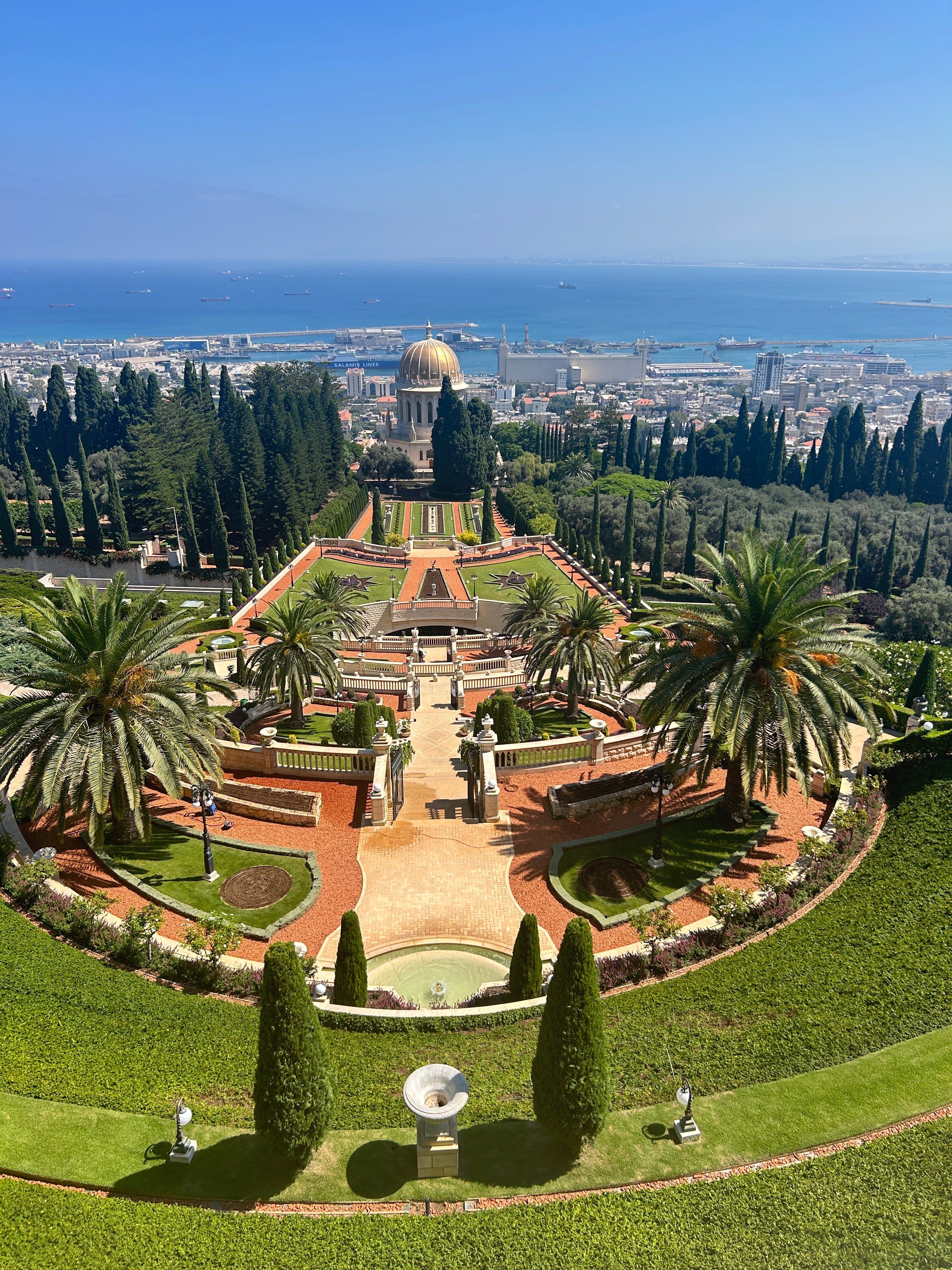
My first stop was the Bahá’í Gardens, the immense green staircase that descends Mount Carmel toward Haifa’s German Colony and the Mediterranean. Photographs capture the symmetry. They do not capture the absurd precision of the place. Every hedge looks as though it has undergone military inspection. Every flower appears to have signed a contract promising never to lean in the wrong direction. Even the gravel behaves itself—which, in Israel, may qualify as an open miracle.
At the center stands the golden-domed Shrine of the Báb. The Bahá’í faith began in nineteenth-century Persia. In 1844, a young merchant known as the Báb proclaimed a new religious mission and prepared the way for Bahá’u’lláh, whom Bahá’ís regard as the faith’s principal founder. The Báb was executed by a Persian firing squad in 1850. Bahá’u’lláh was persecuted, imprisoned and eventually banished by the Ottoman authorities to Acre in 1868. That exile tied the new faith to this corner of the Land of Israel. The Báb’s remains were later brought to Mount Carmel, and the shrine and terraces developed into the spiritual and administrative heart of the Bahá’í world.
The gardens contain nineteen terraces, reflecting a number with deep importance in Bahá’í tradition. They form a straight, almost ceremonial line down the Carmel, with the blue Mediterranean beyond them and the port spread below. It is one of the great urban views in the country.
I am an Orthodox Jew. Visiting a beautiful place does not require me to dissolve my beliefs into a bowl of interfaith porridge. I did not go to participate in another religion, borrow its rituals or pretend that every theology says the same thing in different hats. It does not. I went to see a remarkable work of human design and to witness one of the clearest demonstrations of what Jewish sovereignty looks like when it is confident.
Israel protects this site. Think about that for a moment. The Bahá’í faith was born in Iran, where Bahá’ís have endured relentless persecution. In the Jewish state, their world center sits openly on Mount Carmel, its golden dome shining above a mixed Jewish-Arab city. The Middle East is crowded with regimes that cannot tolerate the wrong prayer, the wrong opinion or, on a particularly nervous Tuesday, the wrong haircut. Israel protects a minority faith’s holy places and lets its gardens dominate the skyline. Irony, apparently, has excellent irrigation.
Below the terraces lies the German Colony, founded by German Templers in 1868—the very year Bahá’u’lláh arrived as an Ottoman prisoner in Acre. That single date captures Haifa perfectly: religious movements, imperial decisions and foreign communities all arriving on the same patch of coast, each leaving another layer behind. Haifa is not a museum set. It is a city built out of overlapping footnotes, except the footnotes have balconies, cafés and impossible parking.
The cable car: because roads are for flatter cities
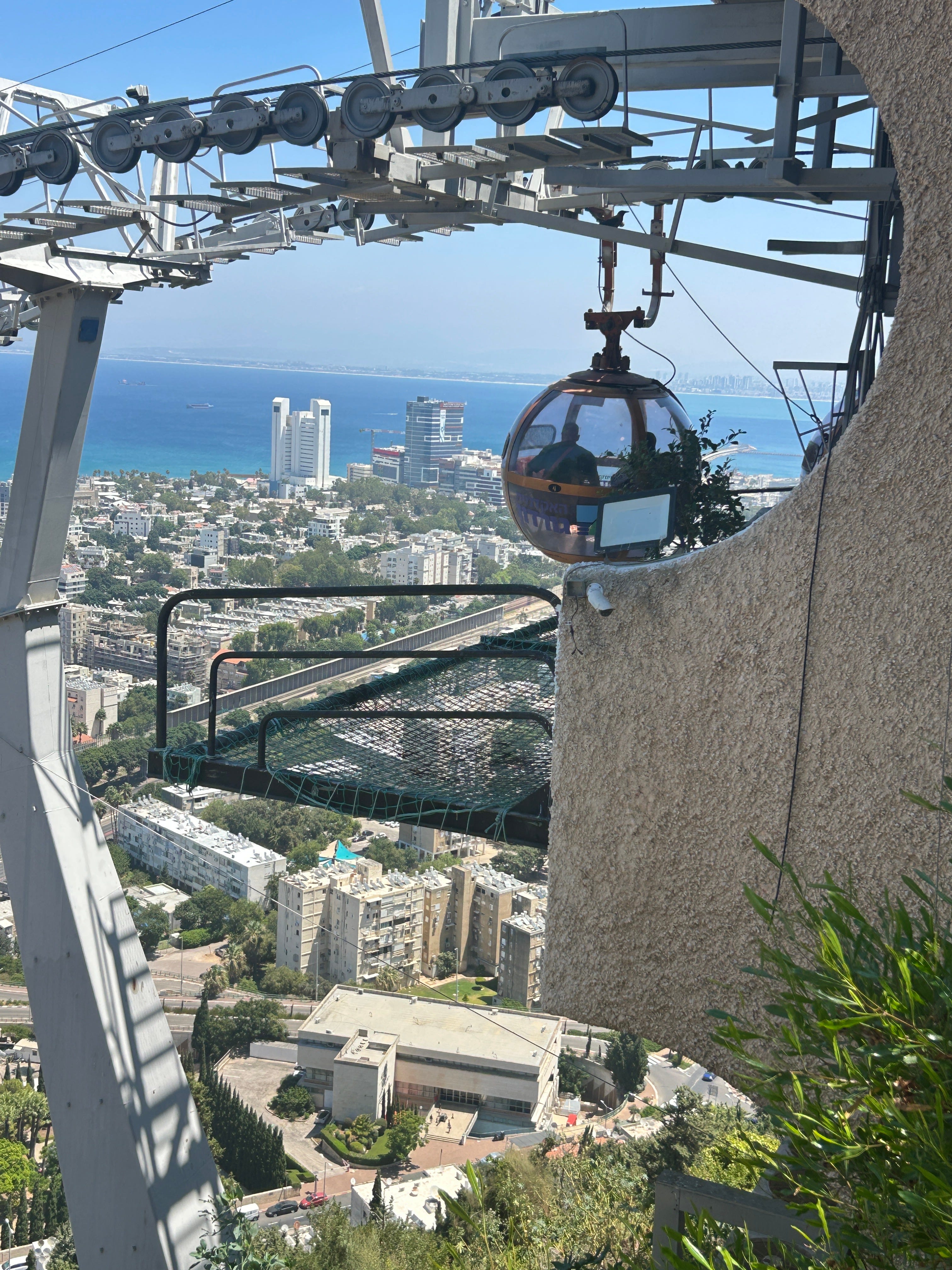
From the gardens I took a bus toward the cable car linking Bat Galim with the Stella Maris ridge. Haifa does not merely sit on Mount Carmel; it clings to it, argues with it and occasionally hangs public transportation from a wire above it.
The small cable cars rise beside the cliff with the Mediterranean opening beneath them. One moment you are near the water; minutes later you are looking across the bay from the Carmel. The geography explains Haifa’s entire personality. Jerusalem faces inward, toward stone, memory and holiness. Haifa faces outward, toward ships, trade, movement and the horizon. Yet Mount Carmel carries its own fierce biblical memory. This is the landscape of Eliyahu HaNavi, where the prophet confronted the priests of Baal and demanded that Israel stop limping between loyalties. Long before cable cars floated over Bat Galim, Carmel was already a mountain of Jewish conviction.
The area around Stella Maris also reflects the city’s religious complexity. Jewish, Christian and Muslim traditions have all attached meaning to sites on the Carmel. I can recognize that history without compromising who I am. My frame remains Jewish, Orthodox and unapologetic: this is the mountain of Eliyahu, overlooking a modern city in a sovereign Jewish state. Religious freedom does not require Jewish amnesia. In fact, it works best when nobody is forced to forget who they are.
And then there is the cable car itself, bobbing above the cliff like a glass egg that has made several questionable life choices. It is scenic, slightly strange and completely Haifa.
The museum where “nevertheless” became policy
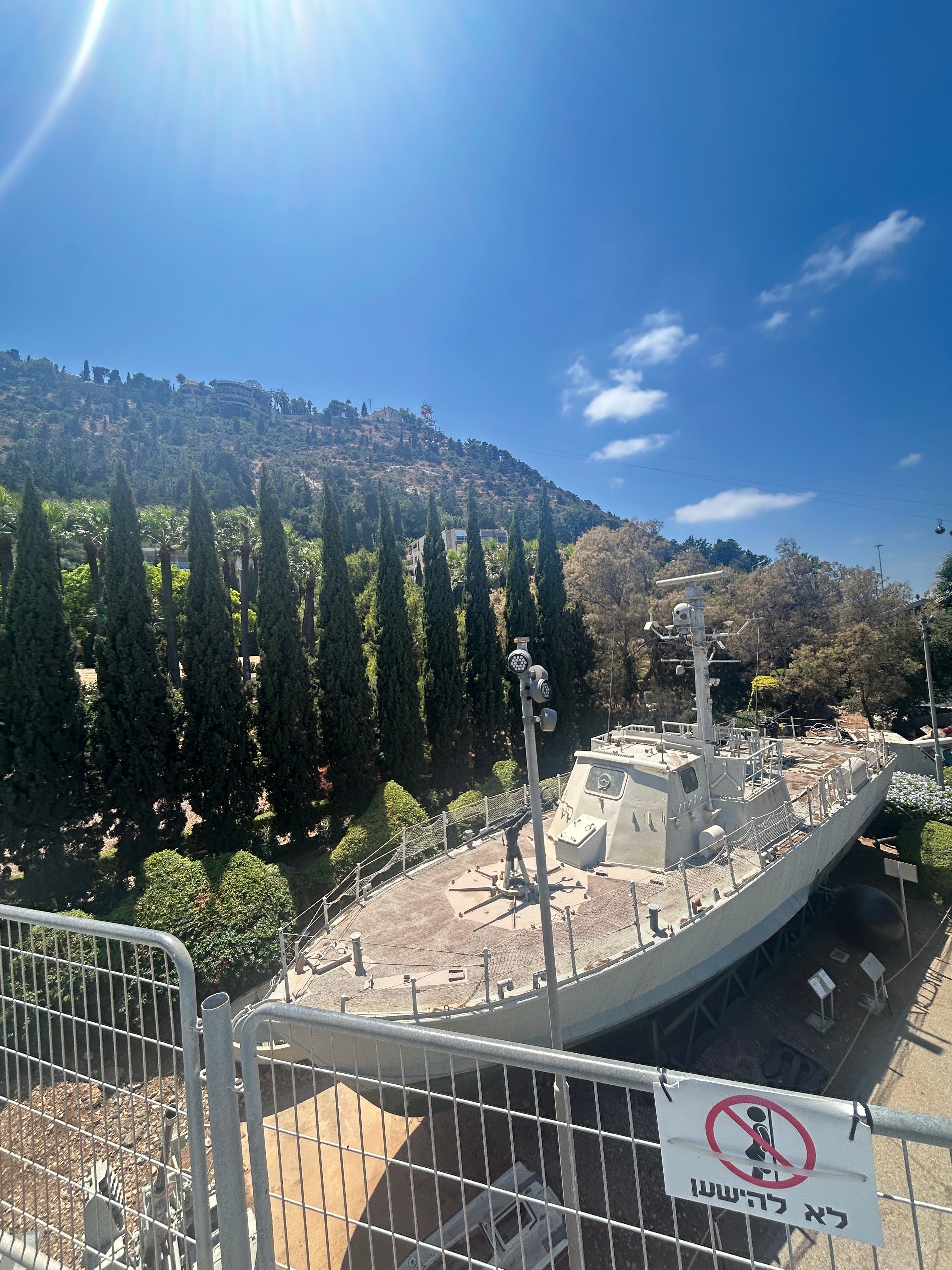
Near Bat Galim, I visited the Clandestine Immigration and Naval Museum. This was not merely another stop. It was the emotional center of the day.
The museum tells the story of Ha’apala—the effort to bring Jews into Mandatory Palestine in defiance of British restrictions—and the creation of Israel’s navy. The underground immigration operation was also known as Aliyah Bet. It was organized largely through the Haganah’s Mossad LeAliyah Bet, with the Palyam, the Palmach’s naval arm, providing commanders and crews. Its mission was brutally simple: bring Jews home when the gates had been slammed shut.
Britain issued the White Paper of 1939 just as Europe was becoming a death trap. Jewish immigration to the ancestral Jewish homeland was sharply restricted at the precise moment Jews needed escape most. The bureaucratic language sounded clean. Bureaucratic language always does. Behind the quotas were human beings trapped under Nazi rule while British officials guarded the coast of Palestine from Jewish refugees.
After the Holocaust, survivors crowded onto aging ships in European ports. They had already endured ghettos, camps, forests, hiding places and death marches. Then they were told that reaching the Land of Israel required one more confrontation—with the Royal Navy.
The ships of Aliyah Bet were rarely luxurious. Many were old, overloaded and dangerously unsuited to the voyage. Passengers slept packed together with little food, poor sanitation and no guarantee that the vessel would reach shore. British patrols intercepted many of them. Refugees were taken to detention camps at Atlit or deported to camps in Cyprus. The Exodus 1947 became the most famous case: thousands of Holocaust survivors were seized by the British and forced back to Europe. Nothing says imperial wisdom quite like putting Jewish survivors behind barbed wire after liberating them from behind barbed wire.
The museum’s centerpiece is the ship Af Al Pi Chen—Hebrew for “Nevertheless.” That name contains an entire national character.
You cannot come in.
Nevertheless.
The British Navy is waiting.
Nevertheless.
The world has abandoned you, Europe has murdered your families, and diplomats are preparing another very serious document.
Nevertheless, the Jews are going home.
Standing beside that vessel, Aliyah stops being an abstract chapter in a history book. You see the cramped interior. You imagine survivors at sea, chased by the fleet of an empire because they insisted on living as Jews in the Land of Israel. The State of Israel was not presented to us at a polite ceremony because the international community finally developed a conscience. Jews organized, sailed, fought, absorbed refugees and built the machinery of sovereignty while much of the world explained why the timing was inconvenient.
Haifa was central to that transformation. Its modern importance grew under Ottoman and British rule. In 1761, the regional ruler Zahir al-Umar relocated and fortified the town. In the late Ottoman period, rail links tied Haifa to the interior and to Damascus. Under the British Mandate, a deep-water port, railway infrastructure, oil facilities and heavy industry turned Haifa into a strategic hub. By 1948, whoever held Haifa held one of the essential gateways into the country.
The city became a gateway not only for cargo but for Jews returning from Europe, North Africa, the Middle East and beyond. The story moves naturally from clandestine ships to the Israeli Navy because sovereignty changed the question. Before 1948, Jews needed secret networks to reach their own homeland. After 1948, a Jewish state could defend its coast, open its ports and decide for itself that Jewish refugees would never again need foreign permission to come home.
That is Zionism in steel, saltwater and stubbornness.
Sand kingdoms beside the real one
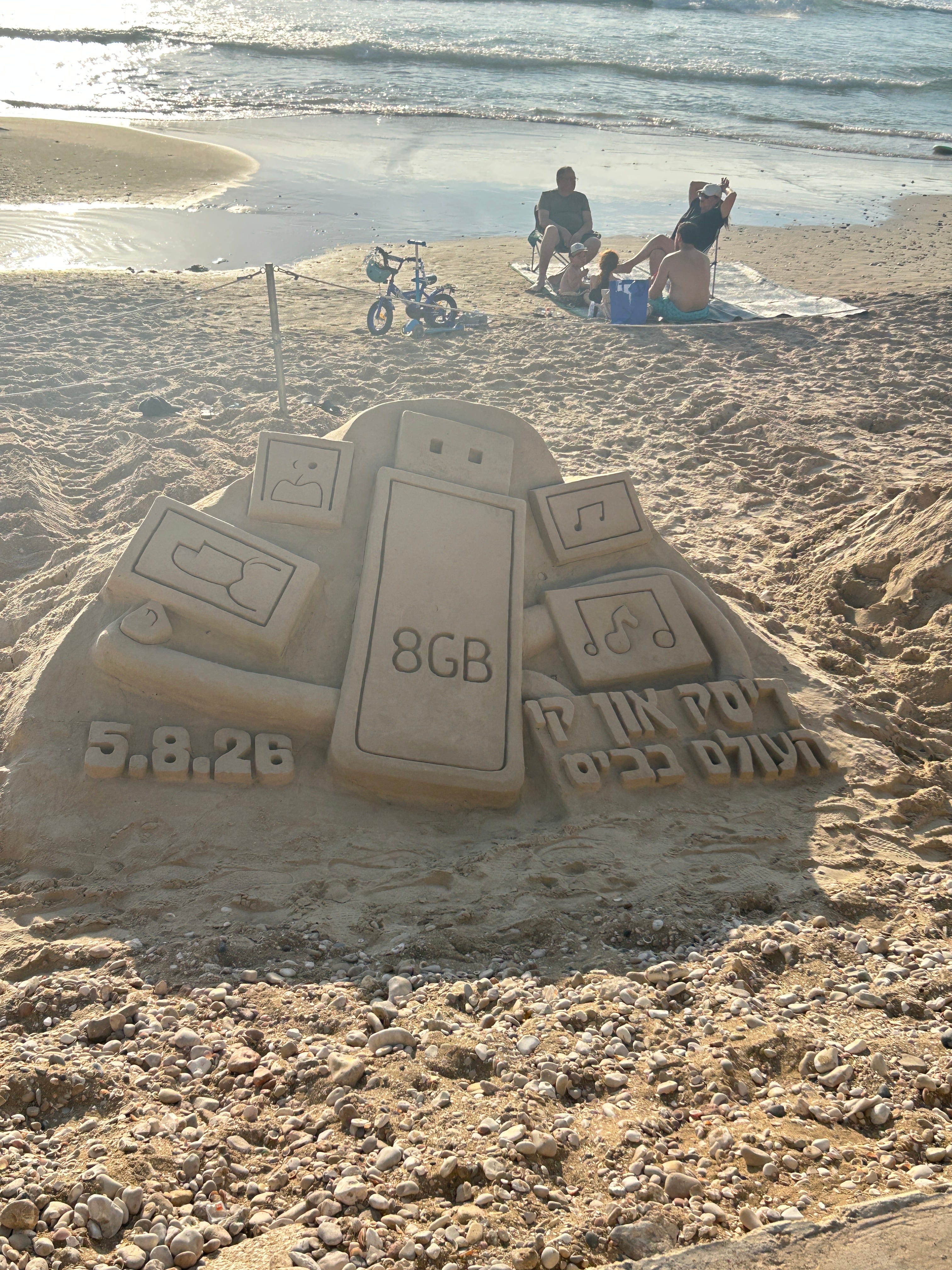
After the museum, I went to the sandcastle exhibition on Haifa’s beach. The transition was wonderfully Israeli: one minute I was staring into the hold of an immigration ship and thinking about the British blockade; the next I was inspecting giant sculptures made from beach sand while children ran around with kites.
The sculptures were intricate, enormous and completely vulnerable to wind, water and one determined five-year-old. Artists had turned ordinary sand into towers, faces, creatures and entire imaginary worlds. It was playful, technically astonishing and a perfect excuse for adults to stand around pretending the children were the reason they wanted to see it.
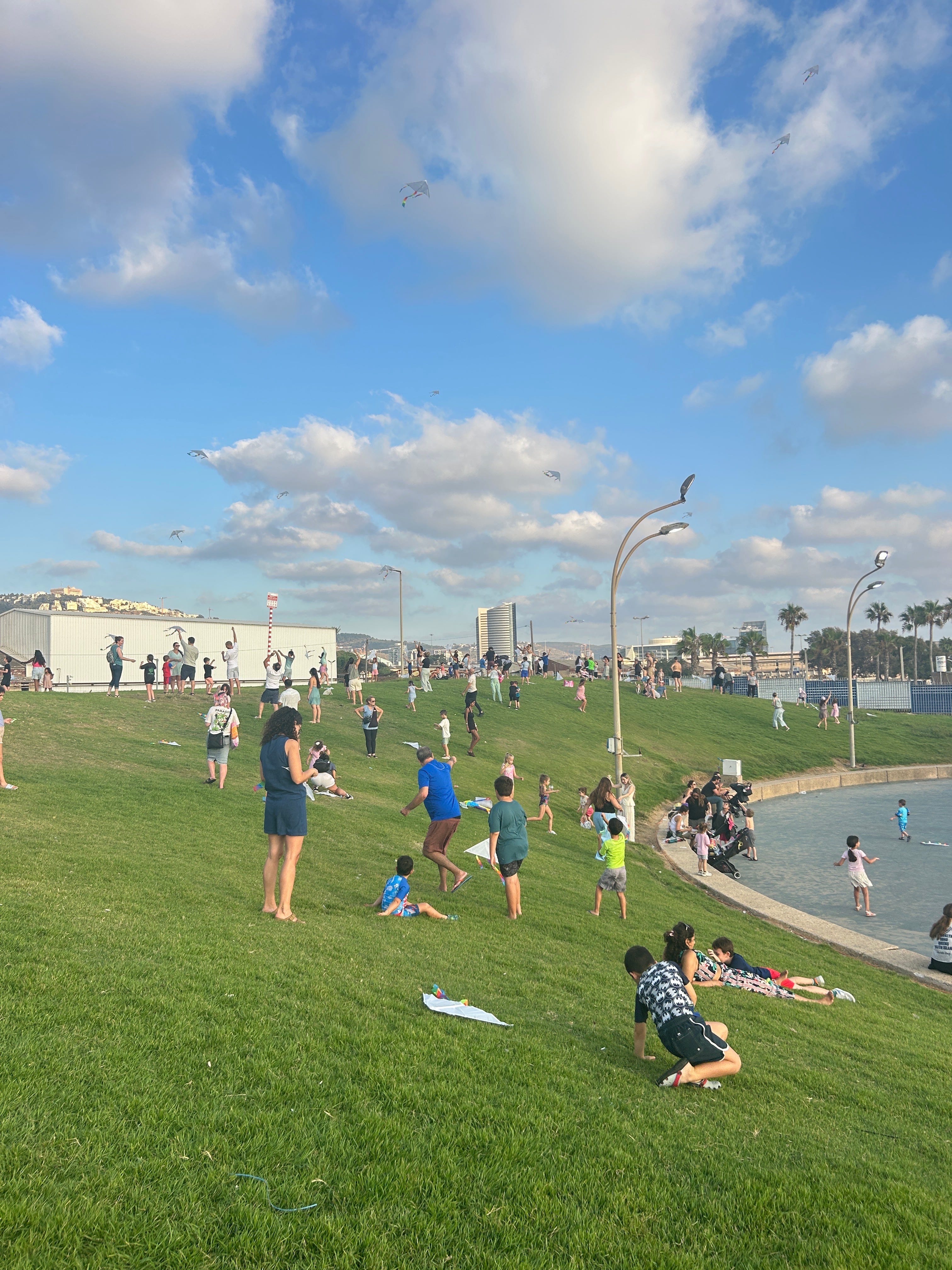
Beyond the exhibit, the real Haifa was carrying on. Jewish and Arab families shared the beach. Children flew kites into the same Mediterranean wind. People ate, laughed, argued, took photographs and attempted to stop sand from entering places sand considers sovereign territory. Nobody had been assembled for a diplomatic photo. There was no orchestra playing “coexistence music.” It was simply life.
That matters because Haifa’s mixed character is often described either with syrupy fantasy or relentless doom. The truth is more interesting. Jews and Arabs do not agree on everything. No city inhabited by actual human beings enjoys permanent harmony; most families cannot even agree on air-conditioning. Yet Haifa has developed a daily civic rhythm that is distinctly its own—shared hospitals, universities, businesses, buses, restaurants, beaches and public spaces. Hebrew and Arabic sit side by side. Religious Jews, secular Jews, Muslims, Christians, Bahá’ís and visitors from everywhere move through the same steep city.
This is the Israel television panels rarely show: not an airbrushed utopia, and certainly not the cartoon apartheid state invented by activists who could not locate Bat Galim with a flare gun. It is a loud, imperfect, democratic country in which difference is visible and ordinary. Arabs and Jews flying kites on a Haifa beach will never trend as widely as a riot. Reality has terrible public relations.
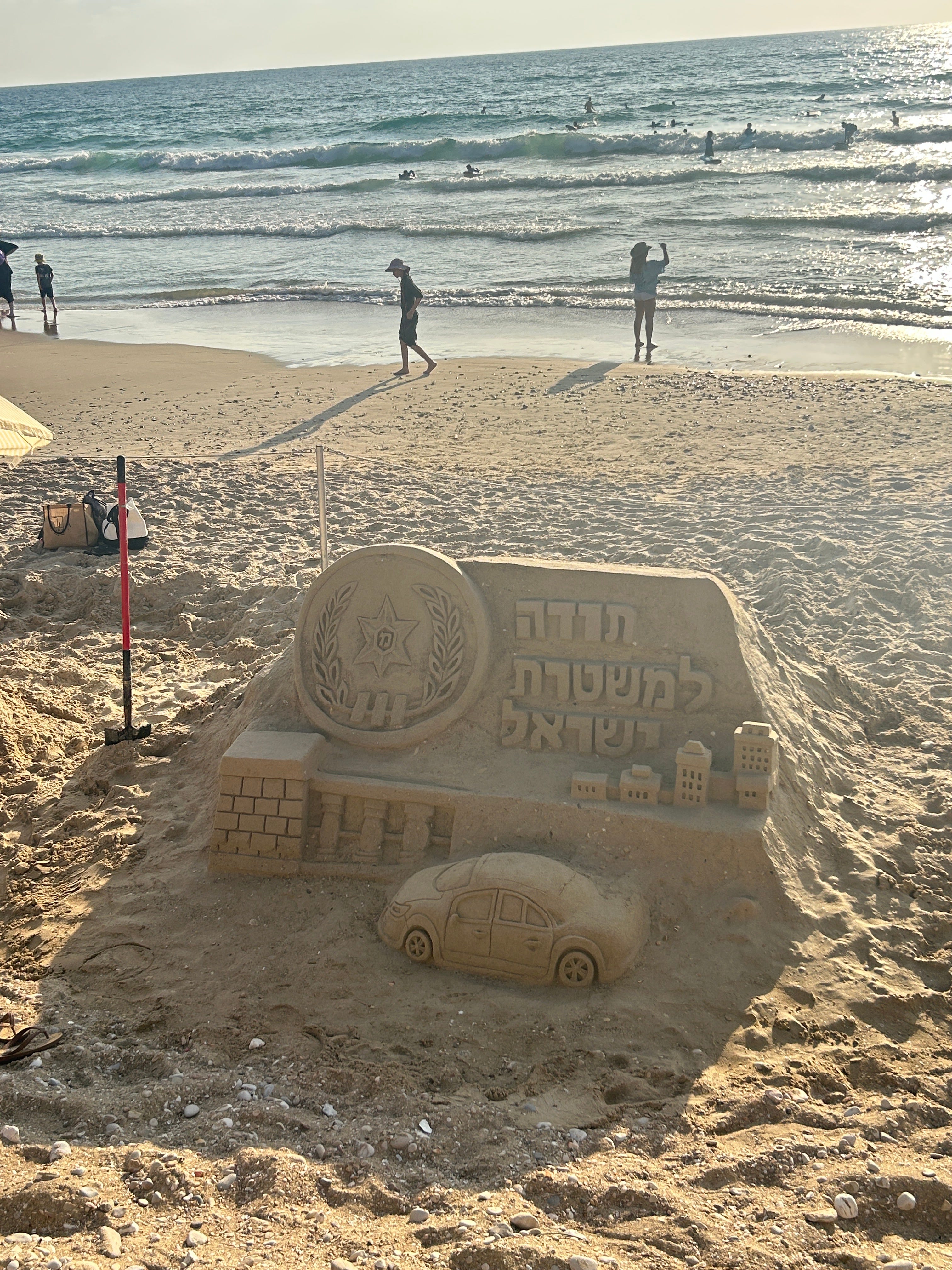
The sandcastles offered their own accidental history lesson. Empires have ruled this coastline—the Phoenicians, Romans, Byzantines, Crusaders, Ottomans and British. Each believed its arrangements were permanent. Most of those arrangements now have roughly the durability of a sand dragon at high tide. The Jewish people, meanwhile, returned, rebuilt Haifa and opened its beaches to the ordinary chaos of life.
Civilization, served cold at Rebar
By late afternoon I reached Rebar at Azrieli Mall Haifa. After gardens, buses, cable cars, ships, museums and beach sand, a cold drink was no longer a luxury. It was emergency infrastructure.
The mall sits in the southern part of the city, another reminder that Haifa is not frozen in its historic port. It stretches along the coast, up the mountain and into modern commercial centers. The city contains oil refineries and research laboratories, ancient caves and high-tech offices, monasteries and synagogues, falafel counters and chain stores. It is both industrial and beautiful—an unlikely combination, like a dockworker who secretly grows orchids.
Rebar restored me to operating condition. Israel has perfected the art of taking fruit, ice and several ingredients I cannot pronounce and turning them into something that convinces you that walking all day was a health decision rather than poor planning.
Then came dinner.
Near the Dan Panorama, where I am staying high on the Carmel, I found a pizza shop serving delicious Italian pizza. This was exactly the correct ending. Not a tasting menu. Not a foam. Not a microscopic tomato resting on a plate the size of the Kinneret. Pizza—hot, generous and capable of settling every argument except whether pineapple is an act of culinary terrorism.
From that part of the Carmel, Haifa spreads below in layers: neighborhoods descending the slope, the golden dome, the port cranes, the curve of the bay and the lights reaching toward the Galilee. The city looks magnificent at night, but it looks earned. Haifa did not become beautiful by hiding its industry, history or contradictions. It put them all on the mountain and switched on the lights.
Come see the Israel that refuses to fit on a poster
Haifa deserves more than a quick photograph of the Bahá’í Gardens before tourists race off to the next famous site. Give it a full day. Better yet, give it several.
Come for the view down Mount Carmel, but learn why a Persian-born faith found safety here. Ride the cable car, but remember Eliyahu HaNavi and the ancient Jewish memory embedded in the ridge. Visit the clandestine immigration museum and stand inside the word “nevertheless.” Walk the beach and watch Jewish and Arab children launch kites into the same sky. Examine a kingdom made of sand. Drink something cold. Eat the pizza. Israel is holy, but holiness does not prohibit carbohydrates.
Haifa is thrilling because it refuses to behave like a single story. It is biblical and modern, Jewish and mixed, sacred and industrial, solemn and ridiculous. It remembers refugee ships while children build castles beside the sea. It protects the gardens of another faith beneath the sovereignty of the Jewish people. It climbs a mountain, hangs cable cars over the cliff and assumes everyone will cope.
This is not the Israel sold by propaganda, either hostile or sentimental. It is better. It is alive.
And tonight, from the Dan Panorama, with the lights of Haifa below and the last evidence of Italian pizza rapidly disappearing, alive looks very good indeed.
Oh how I wish I could be there to see all of these amazing beautiful wonders❣️🙏 Always a pleasure to read your stories and get a glimpse into the wonderful world of Israel! Thank you Yonah for sharing your journey with me, and I hope you and yours are doing great!!!👍 I stand with ISRAEL 🇮🇱 Shalom‼️🙏💕😻
Beautiful Haifa 💙💙